

 Tiếng Việt
In the plastics industry, raw material costs are one of the key factors directly affecting product prices and competitiveness. As Vietnam’s supply of virgin plastic remains significantly dependent on imports, the use of filler masterbatch has become a solution of growing interest among manufacturers.
Made primarily from calcium carbonate (CaCO₃), a polymer base, and suitable additives, filler masterbatch can help manufacturers reduce the amount of virgin resin used, optimize production costs, and improve certain properties of finished products. Below are three industries that can benefit significantly from the application of this material.
1. What is filler masterbatch?
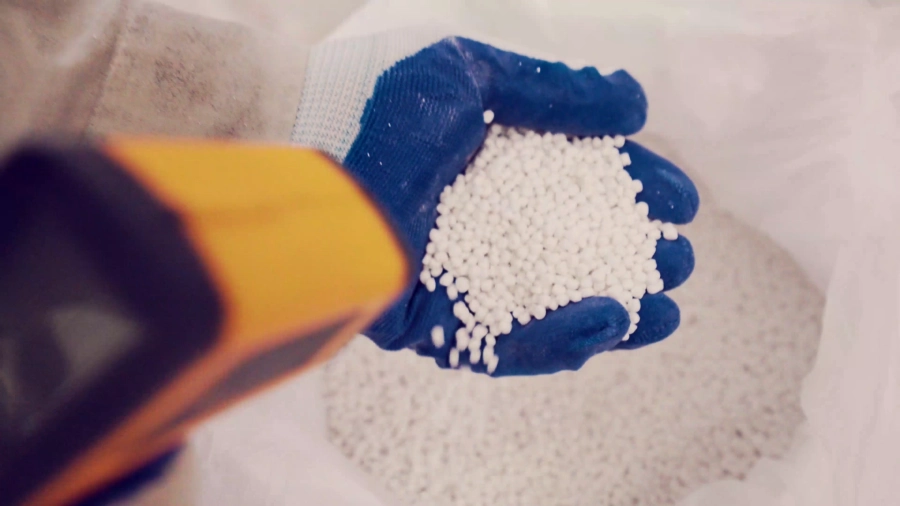
Filler masterbatch, also known as plastic filler, is a material made from high-quality calcium carbonate (CaCO₃) powder, combined with a polymer base and specialized additives.
Unlike virgin plastic, which is mainly derived from petroleum and natural gas, filler masterbatch uses CaCO₃ as its primary filler component. When properly blended with the polymer base, this material can be used in various plastic processing applications.
Depending on the processing technology, polymer type, and product requirements, filler masterbatch can be applied in injection molding, film blowing, thermoforming, and the production of various other plastic products.

2. Benefits of filler masterbatch in plastic manufacturing
The use of filler masterbatch in plastic formulations is not only aimed at reducing raw material costs but can also provide various benefits in processing and finished product properties.
2.1. Plastic packaging manufacturing
Plastic packaging is one of the industries with high demand for raw materials, including shopping bags, industrial bags, food packaging, bottles, containers, lids, and other products.
The use of filler masterbatch in this sector can provide several notable benefits:
Reducing raw material costs
CaCO₃ generally costs less than virgin resin. Adding filler masterbatch at an appropriate ratio helps reduce the amount of virgin resin required, thereby optimizing raw material costs and product prices.
In addition, CaCO₃ has good thermal conductivity, supporting more efficient heating and cooling processes. As a result, the production cycle time can potentially be shortened, helping reduce energy consumption and improve operational efficiency.
Greater control over raw material supply
Virgin plastics are primarily derived from petroleum and natural gas, so their prices are often affected by fluctuations in energy markets and international supply.
Meanwhile, CaCO₃ is abundant in natural resources and can be mined and processed domestically. Increasing the appropriate use of filler materials can help manufacturers reduce their dependence on imported virgin plastic to a certain extent.
Supporting improved product properties
CaCO₃ has a natural degree of whiteness, which can help improve the color and brightness of finished products. This characteristic is particularly useful for plastic packaging, films, and products requiring a bright and clean appearance.
Filler masterbatch can also contribute to improving certain mechanical properties, such as stiffness, flexural strength, and impact resistance. In some formulations, the appropriate use of filler can help maintain tear resistance even when product thickness is reduced.
Reducing the use of fossil-based plastics
When filler masterbatch replaces part of the virgin resin in a formulation, the amount of fossil-based polymer used in the product can be reduced. This approach can help manufacturers optimize raw material consumption and reduce the environmental impact associated with the use of fossil-based plastics.
2.2. Household plastic products manufacturing
Household plastic products such as storage containers, trays, basins, cups, plates, and other items often require a balance between durability, stiffness, appearance, and production costs.
Filler masterbatch can be used in various processing technologies, particularly injection molding and thermoforming.
For thermoforming applications, the good thermal conductivity of CaCO₃ helps the material heat up quickly and relatively evenly. The cooling process can also be improved, creating favorable conditions for increasing line speed and production output.
In addition, filler masterbatch can help:
- Increase product stiffness.
- Reduce shrinkage after processing.
- Improve product forming performance.
- Reduce friction during processing.
- Reduce load on equipment and pressure at the extrusion die.
- Support shorter cooling times.
- Improve production efficiency and optimize costs.
2.3. Manufacturing HDPE, PP, and PE plastic pipes and profiles
Plastic pipes and profiles are widely used in construction, water supply and drainage, industrial applications, and many other fields. Due to the need for high production volumes and consistent product quality, optimizing raw material formulations plays an important role for manufacturers.
Filler masterbatch can be blended with plastics such as HDPE, PP, and PE to reduce the amount of virgin resin used, thereby helping control raw material costs and product prices.
In addition to economic benefits, CaCO₃ can help improve stiffness and processability. Its good thermal conductivity also facilitates the cooling process, helping shorten production time and increase manufacturing efficiency.
3. Why is filler masterbatch becoming increasingly popular?
The growing use of filler masterbatch is driven by the need to optimize costs and improve production efficiency in the plastics industry. When the appropriate polymer base, mixing ratio, and additive system are selected, filler masterbatch can help manufacturers achieve multiple objectives, including:
- Optimizing raw material costs by reducing the amount of virgin resin required.
- Supporting higher productivity thanks to the thermal conductivity of CaCO₃.
- Improving certain mechanical properties such as stiffness, flexural strength, and impact resistance.
- Supporting better appearance control due to the natural whiteness of CaCO₃.
- Improving processability across various manufacturing processes.
- Reducing the amount of fossil-based polymer used in certain product formulations.
However, the effectiveness of filler masterbatch depends on the quality of CaCO₃, the polymer base, additive system, loading ratio, and processing technology. Therefore, manufacturers should select a filler masterbatch that is suitable for their specific products and production conditions to achieve optimal results.
Conclusion
From plastic packaging and household products to HDPE, PP, and PE pipes and profiles, filler masterbatch has become a useful material for optimizing plastic manufacturing processes. In addition to reducing raw material costs, plastic filler can help improve processability, productivity, and certain product properties.
Selecting the right filler masterbatch for each type of plastic and product requirement is therefore an important factor in maximizing the benefits that this material can provide.